The problem statement
Given the head of a linked list and an integer val, remove all the nodes of the linked list that have Node.val === val, and return the new head.
Understanding the problem
Problem Statement
Given a singly linked list (i.e., each node has a next pointer only), the goal is to remove all nodes that have a value equal to a specified value.
Recursive Approach
- The process involves recursively traversing the linked list.
- At each step, the function makes a recursive call for the
nextnode of the current node (head.next).
Base Case
- The recursion terminates when the current node (
head) isnull. In this case, the function returnsnull. This base case is crucial for stopping the recursion.
Removing Matching Nodes
- After the recursive call, the function checks if the value of the current node (
head.val) equals the specifiedvalue. - If it does, the current node is skipped by returning
head.next. This effectively removes the current node from the list as the parent node in the call stack will now point itsnexttohead.next. - If the current node's value does not match
value, the current node is retained by returninghead.
Result
- This approach ensures that all nodes with the value equal to
valueare removed from the list. - The list is updated in place, and the modified list is returned.
Examples:
Example 1:
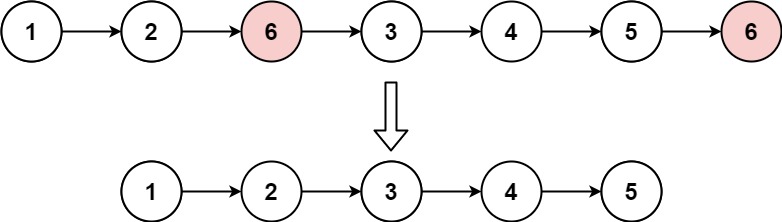
Input: head = [1,2,6,3,4,5,6], val = 6
Output: [1,2,3,4,5]
Example 2:
Input: head = [], val = 1
Output: []
Example 3:
Input: head = [7,7,7,7], val = 7
Output: []
Code solution
function removeElements(head: ListNode | null, val: number): ListNode | null {
  if (!head) return null;
  head.next = removeElements(head.next, val);
  return head.val === val ? head.next : head;
}
Key Takeaways
- Read the question!! I first implemented a solution for doubly linked lists and then realised it was for singly.
- Recursion is becoming easier to visualise the more that I do it.